Something occurred to me watching Infinity War: a key difference in how the Russos see Vision vs how Whedon saw him.

image

The Russos see Vision as someone who was going from robot to person, someone who was gaining his humanity slowly as he developed more human emotions, but Whedon saw Vision as someone who was born more than human. Bear with me:

I’ve talked about how Age of Ultron goes way out of its way to establish Vision is a Real Person, android or no. But there’s also an important element Whedon emphasized as being somewhat more than human. There’s the subtle-as-a-marching-band messianic imagery of Vision both in the movie and in the marketing:

image

But I think it’s easiest to identify in his last conversation with Ultron–the final words he speaks in the movie and therefore what our final understanding of the characters are meant to rest upon. Ultron is locked into the confused and broken perspective of a doomed, worthless human race because he’s incapable of changing. He “misses” the beauty of them because he is too machine to perceive it.

image

Vision, despite being born predisposed towards that same confused hate and violence quickly forms new opinions and comes to an independent conclusion.

image

They are positioned as opposites, foils, counterparts–where Ultron is the most regressive take on the ultimate answer to the worthiness of humanity, Vision is therefore positioned as having the most enlightened one.

image

There’s nothing less than human about Vision in Age of Ultron. What feels inhuman about him is not the machine part of him, it’s the ethereal.

But then we get to Civil War.

I’ll start off by saying, the Russos are clearly more comfortable with “grounded” characters. They have frequently talked about their desire to ground characters in interviews, and I think that extended in being too uncomfortable with Whedon’s take of an angelic, Lamb of God android. Or they perhaps were simply predisposed to think of a synthetic character as needing to rise up to humanity and saw Vision’s character in AoU through that lens.

But this means when we are introduced to Vision, we go from a character who immediately grasped the social importance of clothes[1] to needing multiple discussions on the concept of privacy.

image

One of the most important distinctions is I think subtle, but inarguable if taken together: Vision is actually very empathetic and able to read emotionally complex situations with relative ease.

From being the only character to have compassion for Ultron and express an emotional, nuanced take on the mission to stop him (vs Civil War Vision seeing things in terms of equations and action vs reaction):

image

From understanding the unspoken implication of threat from Bruce that Bruce himself wasn’t fully aware he was making (to missing quite a bit of Wanda’s underlying feelings):

image

From the display of very genuine trust and empathy to a heretofore antagonist Wanda (to being a bit too obtuse in his attempts to comfort Wanda, if in a very well-meaning way):

image

Nothing suggests in Age of Ultron that Vision has trouble with social cues or feelings. Yet that his main arc in Civil War.

I think some of this might be responsible for the disconnect people feel with Vision’s humanity now–even though it wasn’t intentional, I think much of the audience instinctively were clued in to the fact Vision seems to have regressed, and some of the interest piqued in AoU was likely deflated when he was functionally almost a different character.

It might be that since I’m talking about how I feel the Russos started off Vision as somewhere not fully human sounds like a criticism of them or their version of Vision–but it’s not. I think I might have personally preferred the take of Vision coming down to humanity’s level via his love of a very much human woman[2] rather than the much more done take of “What is this thing you call love?”, but that’s simply a matter of personal preference from me. One is not inherently superior to the other.

It’s a different approach to the character, but I think the end goal was the same for the Russos and for Whedon: Vision as Wanda’s equal.

image

[1]Not to mention, clothing oneself is a highly important symbolic gesture of civilizing and humanizing oneself, from The Bible, to the Epic of Gilgamesh, to Lord of the Flies.

[2]Despite the Russos many interviews stating Wanda’s arc is meant to show how she is moving away from humanity, they either really missed the mark, are saving that for A4, or simply changed their minds, because Wanda is never more human than in Infinity War.
Hey people with the “Okoye was willing to kill her husband but Wanda won’t kill Vision” hot take

Okoye is also supporting the plan to try and save Vision. She also doesn’t think an innocent woman has to kill an innocent man when there’s an alternate solution. She recognizes the difference between that situation and the one with a traitor to her country who was trying to help kill the royal family and take over the world.

I wish that the writers of Infinity War had shifted the timeline of the moral crisis with Vision somewhat.

I think that introducing the idea that Wanda could destroy the Mind Stone and then have her refuse the option (even just as an emotional reflex) primed some of the audience against the decision to go to Wakanda. While I have talked extensively on the importance of this decision and why some extra consideration should be made, it’s always going to be really hard to hear the stakes are ‘half of all life’ and have sympathy for people debating the value of a single one.

Instead, I wish the writers had introduced the idea of extracting the Mind Stone to hide it first. Bruce could mention that he and Tony’s research in Age of Ultron showed no energy on Earth could destroy it; Steve could mention Wakanda having the tech to extract it.

Then, at Wakanda while Shuri is investigating, have Vision say exactly what he originally said in IW: he’s done some analyzing and figured out the type of energy Wanda’s power is could destroy the Stone.

Now the decision to destroy Vision stands on equal footing to the possibility of saving him. Now we have time to focus a bit on the Wakandans feelings (who, in the original movie do clearly support the idea of trying to save Vision but seem more passive in the decision), to more clearly establish they are on board with saving him.

It also would have strengthened the parallel between Thanos’ experience with his people and the Avengers with Vision. On Titan, the option to kill half of everyone wouldn’t have come before the various solutions they would have attempted to fix overpopulation. That would have been introduced later, only to be dismissed while prior solutions were still attempted.

The movie can continue exactly as before, but I think the audience would have had more time to process the choices, to sympathize and engage, instead of reflexively objecting to it.

There’s a point in this fandom where you’ve watched so many of Paul Bettany’s interviews you can guess what Paulism he’s about to say next:

“Like being in a gin and tonic…”

“Bags of cash”

“Snitches end up in ditches with stitches.”

“It’s about learning what loyalty is, and that true loyalty comes from love”

*the producer story about never working in Hollywood and going to that sidewalk*

“Well, I’m a robot… and she’s a witch… “

sNITCHes end up iN dITCHES with stiTCHES”

orderchaoslove:

Can someone please clarify for me; at the beginning of Infinity War are Vision and Wanda staying at an apartment or a motel?? Because I thought it was an apartment but Sam mentions that they’ve been staying at motels. I personally thought Wanda was living apart from the other fugitives for some reason, or are Vision and Wanda staying at motels when they see each other???

I need answers, or at the very least, other people’s headcanons. Help me out?

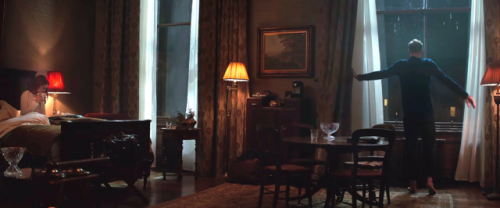
It’s very likely a hotel. I remarked on it here that you can see luggage at the foot of the bed, a service cart in the bottom left, a service card and glass in front of the left window. The decor is very hotel like what with the generic landscape, the bland patterned wallpaper, the generic 90s lampshades, the small dining table in the middle of the “bedroom”.

image

Plus, the set designers would have gone nuts for the opportunity to flesh out a superhero love nest–remember how detailed Cap’s office in Civil War was? Most of the detail you can’t even see in the movie, but it’s loaded with little things. But they chose a very generic, impersonal look.

The point of the dilemma about Vision’s life was not to ultimately answer “Yes, turns out, one life IS worth trillions, who knew?”

The point is to show us how that decision changes when there’s a third option.

They don’t want to murder an innocent person because he happens to exist in the wrong way. They don’t want to make another innocent person murder him. And they don’t have to! They can extract the Mind Stone, have Wanda destroy it, and be True Heroes All Along. They can be noble, heroic, and be satisfied they did the morally correct thing.

You know, like Thanos’ people tried to do.

And that’s the point. The parallel between two situations in taking a third way out that means not having to commit a terrible act until it’s too late.

But there’s a catch here–Thanos has the power of inevitability on his side. He has the Time Stone. It wouldn’t have mattered if Wanda had or hadn’t. Whether Wanda did it earlier or later.

And that’s the thing, Thanos’ plan is short sighted. People will continue to populate, resources will continue to dwindle. That’s inevitable too.

So now or later, here or there, “destiny arrives”. Thanos is only delaying it—and he plays a cold numbers game to do so.

What separates him from the heroes isn’t that heroes aren’t willing to. Quill and Wanda both try. It’s that they’re willing to try something else first. Because destiny is always going to arrive one way or another—but they’re going to fight for something better.

Listen, I’m gonna talk about how Vision is a person and how much I Do Not Get how people have trouble accepting this.

This is a character who has like four separate scenes in Age of Ultron alone dedicated to establishing his personhood. The Avengers Tower scene to establish that the hammer really does judge worthiness, there’s Scarlet Witch reading him to establish his mind is definitely like a human being, we have Vision declaring himself an individual, we have Vision lifting the hammer and establishing Mjolnir has judged him a worthy person.

“BUT WAIT THERE’S THAT THING ABOUT HOW HE’S BASICALLY AN ELEVATOR, BASICALLY”

NO. You have bad narrative comprehension! Your English teacher failed you! Putting aside that Thor laughs dismissively at those comments, there is no point to Vision lifting Mjolnir if it has no meaning!

This is like watching Titanic and going “hey, but Rose DID just let Jack go! What the heck movie, she just said she wouldn’t!” Like, yeah, maybe I get if you completely missed everything related to character, narrative, or thematic resonance, that’s how you can interpret it… but for everyone else, Vision is worthy because he’s worthy.

Is it just a matter of looking at the smallest, most passing view of a character and making a decision based solely on that? Is this like watching Civil War and going “Hey, that Captain America guy isn’t pro-government anymore! But he’s called Captain America and that sounds pro-government to me! What the heck!” and having missed the last two movies that are explicitly about him defying government authority? So, like just looking at Vision and going “oh, android” and deciding that’s it, that’s the character, no further thinking needed.

And, hey, maybe Age of Ultron didn’t convince you. He’s too perfect, and he sounds just like JARVIS, so maybe he’s just following a set of protocols! “Okay,” say the writers, “How about a movie where he gets caught up in his emotions, makes mistakes, has regrets, and changes? That’s what real people do!”  

“NO.” you say. “HE’S GOT LIKE PURPLE CIRCUITRY STUFF ON HIS FACE AND IT DOESN’T COUNT.”

“Really? Ok. Well, THIS movie is about how Vision starts off by deciding he doesn’t want to be loyal to any specific team, but the person he loves, thus defying any semblance of protocol loyalty to Tony. Only to make the choice to let his own actualized life be taken by the woman he loves to save trillions. Tragically being destroyed to do what he was created for (to protect life), by who he wanted to live for (his love, Wanda).”

And at this point I can’t even pretend to get into the head of someone who thinks this isn’t enough. Is it like a shipping thing? Is making Vision just a robot like the Wanda/Vision equivalent of making Pepper Potts an abusive shrew so Tony can hook up with whoever? Is it because he wielded Mjolnir, and some people want that big ‘Oooo’ moment to count for their fave instead? Like we have three different movies that are really damaged narratively by refusing to accept Vision as a person. Why even watch these movies? Why even consume any kind of speculative fiction if you only want to accept stuff specifically within your sphere of existence?

I Don’t Get It.

But, it doesn’t really matter. The writers, directors, crew, actors, and everyone else with a say in it make the decisions about this, and they decided to tell a story of a God of Thunder who finds him worthy to defend Earth. Of a war hero who would sacrifice his life to defend him. Of a hardened ex-Russian spy who is deeply struck by his death. Of a woman who loves him till the moment she dies.

And if you insist on believing that this stuff doesn’t count, that Vision’s personhood doesn’t qualify or matter to the narrative, well, that’s your choice. But I gotta say–you’re really missing out.

I know there’s some disappointment that because of the introduction of Vision’s human form, we sometimes see Vision’s android form displaced. But it will always be a net gain for me, because it means we might be able to get Vision cameos in lower production stuff.

And by lower production stuff I mean One Shots.

And by One Shots I mean Marvel please give me a short film of Wanda and Vision falling in love set to the music of Paperman set in the style of the first 7 minutes of Up before it gets sad.

In Age of Ultron, Wanda’s arc was about doing something wrong when she thinks it’s for something right.

In Civil War, Wanda’s arc was about doing something right, and still having it go wrong.

In Infinity War, Wanda’s arc is about having to do something wrong, when doing it is the right thing.

magistrate-of-mediocrity:

those-celestial-bodies:

Okay, quick theory.

The writers have said that those dead are going to stay dead. I think probably they’re trying to to word things carefully so that what they really mean is: “Characters who are ACTUALLY dead at the end will stay dead”, and we’ll learn that the dusted Avengers are still alive, so they were never technically lying. But it did get me thinking.

So if they do really mean the dusted Avengers are for sure dead and will stay dead, while also accepting there’s no possible way they are permanently killing off Spidey, Black Panther, and Strange there’s really only one solution I can think of:

What if, in an alternate universe, the Avengers that got turned to ash in our reality are the ones that survived, and those that lived got turned to ash?

And, ultimately, the way to “fix” what happened is to merge the two realities? That would mean the “original” Avengers we knew are dead and stay dead, but we still have these characters going forward.

But that leaves Vision in limbo.

It does; Vision’s fate isn’t going to end up falling under the same umbrella. If we’re going with the parallel reality, then he’s dead in both, since Thanos would have needed the Mind Stone (and the writers will think it’s cheap to have him conveniently never killed).

Maybe more importantly, so is Shuri (assuming she’s alive in ours)*, Tony, and Bruce–the people who have the capability to fix him. So if Vision’s fate is to get fixed by them or a combination thereof, it’s going to happen in the main universe–so if the rumors of a 5 year time skip are true, it means that they haven’t seen each other in that time.

There’s also the possibility that Vision consciousness is in the Mind Stone, but that seems less likely if we are dealing with a scenario where there are two Mind Stones, and so, two Visions. Or maybe not. Get it, Wanda.

* Actually that’s an interesting plot thread–what if Shuri and Bruce (and maybe Tony too) are necessary to rebuild Vision? So if Shuri did get dusted in the main universe, it makes it impossible to rebuild him until the two are merged. They were, after all, very careful to remind the audience that Bruce also had a hand in Vision’s creation. Therefore, just as Vision’s death represents the death/division of half the universe, his resurrection would represent the life/unification of them both.