Right? It makes me think about how there were soooo many “android Jesus” and “robot Marvel Superman” references after Age of Ultron came out, and those all drop off come Civil War.
While I think in the long run I would have been happier with the Russos portrayal of Wanda and Wanda and Vision’s romance, I do think that Whedon did a great job of modernizing Silver Age Vision. Silver Age was very unique in being a sympathetic android, and a lot of his character beats might seem a bit trite and overdone now, but were then novel. The idea “even an android can cry” was necessary to show that Vision is equal in his humanity in an era where most robots were like this:
But we have lots of stories like that now (even if some people are still unable to accept non-human personhood like they just walked straight out of the Westworld remake), so the novelty is lost. By making an android who is more than human, though, I think Whedon could capture some of that freshness while staying true to the sentiment.
Something occurred to me watching Infinity War: a key difference in how the Russos see Vision vs how Whedon saw him.
The Russos see Vision as someone who was going from robot to person, someone who was gaining his humanity slowly as he developed more human emotions, but Whedon saw Vision as someone who was born more than human. Bear with me:
I’ve talked about how Age of Ultron goes way out of its way to establish Vision is a Real Person, android or no. But there’s also an important element Whedon emphasized as being somewhat more than human. There’s the subtle-as-a-marching-band messianic imagery of Vision both in the movie and in the marketing:
But I think it’s easiest to identify in his last conversation with Ultron–the final words he speaks in the movie and therefore what our final understanding of the characters are meant to rest upon. Ultron is locked into the confused and broken perspective of a doomed, worthless human race because he’s incapable of changing. He “misses” the beauty of them because he is too machine to perceive it.
Vision, despite being born predisposed towards that same confused hate and violence quickly forms new opinions and comes to an independent conclusion.
They are positioned as opposites, foils, counterparts–where Ultron is the most regressive take on the ultimate answer to the worthiness of humanity, Vision is therefore positioned as having the most enlightened one.
There’s nothing less than human about Vision in Age of Ultron. What feels inhuman about him is not the machine part of him, it’s the ethereal.
But then we get to Civil War.
I’ll start off by saying, the Russos are clearly more comfortable with “grounded” characters. They have frequently talked about their desire to ground characters in interviews, and I think that extended in being too uncomfortable with Whedon’s take of an angelic, Lamb of God android. Or they perhaps were simply predisposed to think of a synthetic character as needing to rise up to humanity and saw Vision’s character in AoU through that lens.
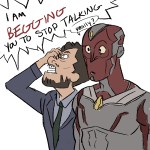
But this means when we are introduced to Vision, we go from a character who immediately grasped the social importance of clothes[1] to needing multiple discussions on the concept of privacy.
One of the most important distinctions is I think subtle, but inarguable if taken together: Vision is actually very empathetic and able to read emotionally complex situations with relative ease.
From being the only character to have compassion for Ultron and express an emotional, nuanced take on the mission to stop him (vs Civil War Vision seeing things in terms of equations and action vs reaction):
From understanding the unspoken implication of threat from Bruce that Bruce himself wasn’t fully aware he was making (to missing quite a bit of Wanda’s underlying feelings):
From the display of very genuine trust and empathy to a heretofore antagonist Wanda (to being a bit too obtuse in his attempts to comfort Wanda, if in a very well-meaning way):
Nothing suggests in Age of Ultron that Vision has trouble with social cues or feelings. Yet that his main arc in Civil War.
I think some of this might be responsible for the disconnect people feel with Vision’s humanity now–even though it wasn’t intentional, I think much of the audience instinctively were clued in to the fact Vision seems to have regressed, and some of the interest piqued in AoU was likely deflated when he was functionally almost a different character.
It might be that since I’m talking about how I feel the Russos started off Vision as somewhere not fully human sounds like a criticism of them or their version of Vision–but it’s not. I think I might have personally preferred the take of Vision coming down to humanity’s level via his love of a very much human woman[2] rather than the much more done take of “What is this thing you call love?”, but that’s simply a matter of personal preference from me. One is not inherently superior to the other.
It’s a different approach to the character, but I think the end goal was the same for the Russos and for Whedon: Vision as Wanda’s equal.
[1]Not to mention, clothing oneself is a highly important symbolic gesture of civilizing and humanizing oneself, from The Bible, to the Epic of Gilgamesh, to Lord of the Flies.
[2]Despite the Russos many interviews stating Wanda’s arc is meant to show how she is moving away from humanity, they either really missed the mark, are saving that for A4, or simply changed their minds, because Wanda is never more human than in Infinity War.
⬆️ Point at this scene when anyone accuses Vision of being useless in Infinity War (plus Vision saving Cap). Being good is less meaningful when you’re too powerful to fear. But Vision can die like a man, so he can be good like one too.
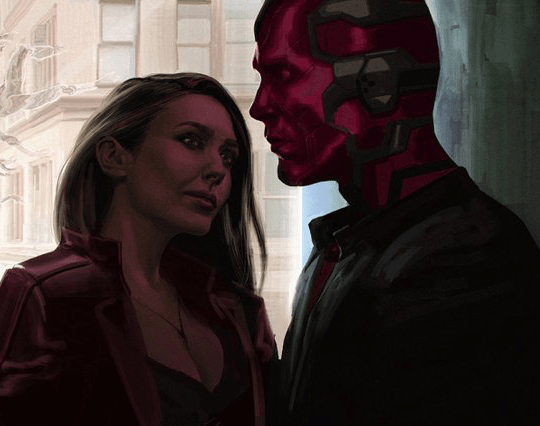
Btw it’s possible he was initially meant to have his android appearance in the early drafts, but both of these images are also previous paintings photobashed into new concept art, just to give an impression of setting, lighting, tone, etc.
I wish that the writers of Infinity War had shifted the timeline of the moral crisis with Vision somewhat.
I think that introducing the idea that Wanda could destroy the Mind Stone and then have her refuse the option (even just as an emotional reflex) primed some of the audience against the decision to go to Wakanda. While I have talked extensively on the importance of this decision and why some extra consideration should be made, it’s always going to be really hard to hear the stakes are ‘half of all life’ and have sympathy for people debating the value of a single one.
Instead, I wish the writers had introduced the idea of extracting the Mind Stone to hide it first. Bruce could mention that he and Tony’s research in Age of Ultron showed no energy on Earth could destroy it; Steve could mention Wakanda having the tech to extract it.
Then, at Wakanda while Shuri is investigating, have Vision say exactly what he originally said in IW: he’s done some analyzing and figured out the type of energy Wanda’s power is could destroy the Stone.
Now the decision to destroy Vision stands on equal footing to the possibility of saving him. Now we have time to focus a bit on the Wakandans feelings (who, in the original movie do clearly support the idea of trying to save Vision but seem more passive in the decision), to more clearly establish they are on board with saving him.
It also would have strengthened the parallel between Thanos’ experience with his people and the Avengers with Vision. On Titan, the option to kill half of everyone wouldn’t have come before the various solutions they would have attempted to fix overpopulation. That would have been introduced later, only to be dismissed while prior solutions were still attempted.
The movie can continue exactly as before, but I think the audience would have had more time to process the choices, to sympathize and engage, instead of reflexively objecting to it.

















 Those Celestial Bodies